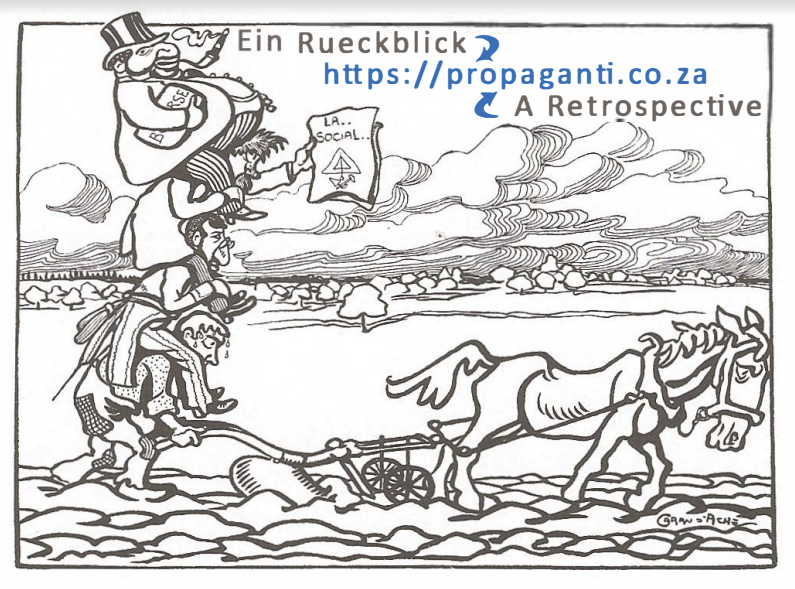


One of their favorite tools became the annual solemn commemorations. The selection grows longer after every armed struggle, Armistice Day, D Day, 70 years of NATO. (brain dead or not) etc. With a lot of pomp and boogaloo, the celebrity’s are seen on such occasions at the various venues. With a serious face, they stride along the Champs-Elisees and hope that no one looks beyond the smoke screen. No one misses the opportunity to present oneself in the limelight once again. Thus, steven Harper, Canadian Prime Minister, was heard in such a self-congratulatory mood: “Canada was forged in the flames on the Western Front.” The Western Front in Alberta and British Columbia was certainly not the point of reference.

The glamorous three, Armistice day, Paris 2019.
On May 8, 2020, there was a new opportunity to solidify the officially approved version of history.
For the 75th anniversary of the German defeat after the Second World War, great, dignified and impressive events were already planned. Such bad luck that a small virus, Covid 19, got in the way of the actors and reduced the celebrations to a bearable level. Thanks to the taxpayer funded, externally controlled media, the message was nevertheless carried far and wide to a huge audience. Russia too, had to be satisfied with a greatly reduced image of being the glorious “liberator”.
Let us return to developments in Southwest Africa / Namibia?
The well established German farmers in the country were lucky not to be deported; unlike officials and other people who could be replaced with South Africans. The secret wish of some who were allowed to stay, that a reunification with the motherland would still be possible did not come true.
Erich Rust was of the opinion that the on-going uncertainty: “paralysed and hindered the desire to work and thrive, especially among the established farmers, far more than war, epidemics, droughts and similar hardships; overcoming the latter is a stimulus which exercises and strengthens the resolve, on the other hand, overcoming the former has a crippling effect.” The method “unsettling and softening up” is increasingly used in the age of uncontrolled mass migration and opportunistic disease control (2015 – 2022).
Before the fighting broke out, the German authorities based their confidence that South West Africa would not be included in the conflict, on three misjudgements.
– The Congo Agreement, a non-aggression pact between the African colonies and the associated great powers, would be strictly observed.
– For the German authorities it was almost inconceivable that Botha and Smuts, who 12 years earlier had to fight heroically and unfortunately in vain against British imperialism, would turn out to be opportunistic turncoats.
– It was also hoped that the Boer rebellion, led by Manie Maritz, could thwart the plans of the South Africans.
As we know, the authorities and the settlers were bitterly disappointed.
Margarethe von Eckenbrecher left valuable information on the early history in her book (Was Afrika mir gab und nahm. Experiences of a German woman in South West Africa 1902-1936). She reported on the journey by ship and ox wagon, the first years in Okombahe, the characteristics of the different black inhabitants of the country. Like the Rust family, their family barely managed to save their lives in the Herero uprising. She recorded interesting details about the time during and after the war.
“The following Reuters telegram, printed in No. 58 – The World War, May 17, 1916, aroused great displeasure.
Lord Robert Cecil said in answer to a question in the House of Commons: ‘We did not take part in the war without the plan to enlarge the empire. We did not conquer the German colonies to free the natives. But I think with a shudder of the possibility of handing over the natives, whom we have freed from German rule, back to Germany again’.”