

The book can only be warmly recommended to those who, in a penitential robe and armed with an irrepressible need for atonement, loiter around various memorials and commemorative events to honour the victims of the “perpetrator nation”. However, it can be assumed that they would be offended by the blunt, honest style of writing that was customary at the time, and which does not at all fit in with the mendacious “new speak” and moral posturing that is popular these days.
The flu also found its way to the home of the Rust family, Ondekaremba; all fell ill, including the black employees. All except Camilla Fels, the then 73 year old mother of Gerda Rust. She stood like a rock in the surge and nursed the sick back to health. After Erich Rust had not seen his old home for 32 years, he travelled to Berlin again in 1934. After his return, Gerda and Erich Rust moved with the now 90-year-old Camilla into a small house at Gododamm, a remote part of the farm. He handed over the farm in two parts to the sons Joachim and Hellmuth. The two other sons Godofred and Martin moved out in order to start their own livelihood, with the support of their parents. Daughter Hanna later married a farmer, Joachim Schierschmidt in the Gobabis District.
“Like I didn’t know what to report about the beginning of my life, I don’t know anything about the end, and I have to leave the writing of the last sentence to another hand. After 66 restless years, I find “being relaxed” so pleasant and beneficial that I would like to say to the current state of relative calm and tranquility: “Stay a while! You are so beautiful! ”(Erich Rust)
In the transcript from 1938 we read: “Our family has grown to five children, four daughters-in-law and currently seven grandchildren without any distressing incidents or serious illnesses ”.
This deliberately cautious remark stands in refreshing contrast to the dramatized outpours with which various highly gifted victim-groups have been showering us endlessly for decades. Spontaneously an old Polish proverb comes to mind: “They whine loudly while they beat down on you.”
The “other hand” that now takes over the writing is the hand of one of Gerda and Erich Rust’s sons.
“I should also tell you about Miss Plew’s fate, who was a very good tutor and co-educator for us children for many years. – Before the war, Remanowski, a farmer, often came to visit our house on the way to Windhoek. He was previously captain of the Schutztruppe, and we children loved and admired him. Of course he fought as a captain during the upheaval of 1914-15, but was subsequently dismissed and became a farmer. He later had to give up his farm, but managed the farm Ekuja. He then proposed to Miss Plew, and they soon got married. The two managed Ekuja for a few more years, then they decided to return to Germany. At the end of the nineteen twenties they were so distressed and impoverished that they committed suicide together. It was very sad news for us. ”(Martin Rust. Ondekaremba. Farm life in South West Africa.)
The incident occurred during the so-called Golden Twenties (1924-1929), the heyday of art, culture and science after the war. The reality, however, didn’t look very rosy. One can clearly gather that the remaining German residents in South West Africa got away relatively unscathed in comparison.
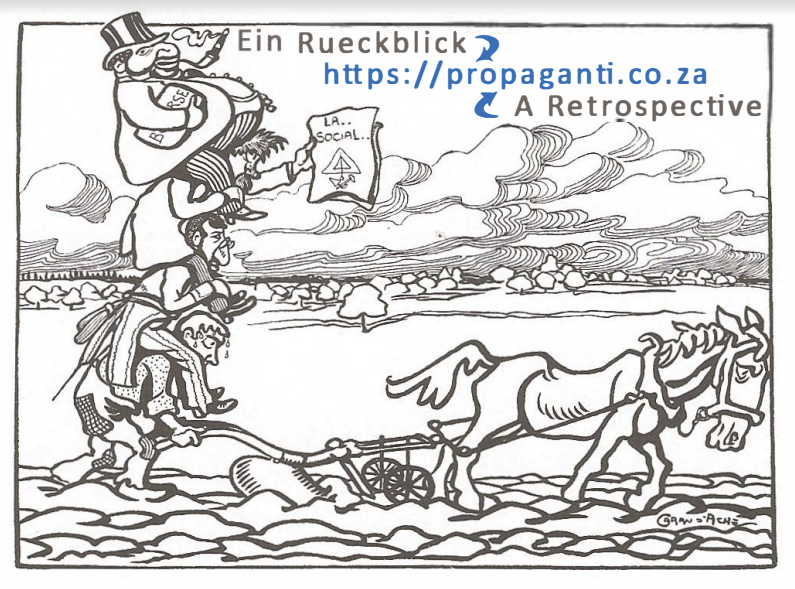
That was the time of the Weimar Republic (1919-1933), the desperate attempts to lead a halfway functional government. Much has been written about this period, mainly negative and opportunistic. However, the accompanying circumstances were brutal and should not be ignored. It was a time when territorial losses and outrageous demands for reparations from the Allies had to be absorbed. This led to hunger – unemployment – hyperinflation – financial collapse – mass strikes – fake referendums – left-wing extremism – inevitably followed by a shift to the right – assassinations and coup attempts. In order to keep the milk cow alive, the Secret Elite (these days called the Deep State) had to make plans.