

It is worth taking a look at the Grosse Brockhaus from 1957 in order to recognize certain parallels to the present.
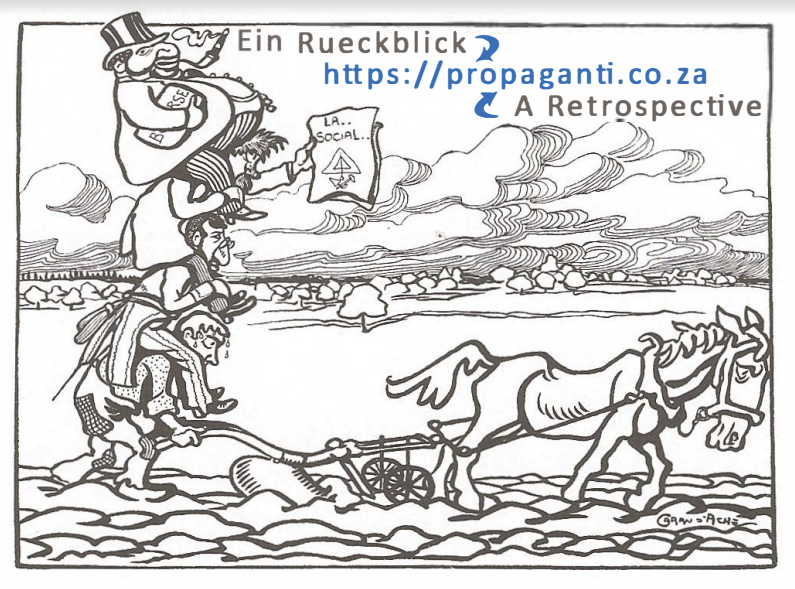
“… but parliamentary absolutism would be prevented by the strong position of the Reich President, who was elected every 7 years by the people and whose authority culminated in the enactment of a state of emergency. Article 48, Paragraph 2 of the Imperial Constitution (emergency ordinance) provided the basis for a possible shift in authority from the ‘party state’ to the ‘presidential republic’ during times of crisis … From the beginning there was tension between the constitutional reality of the ‘party state’ and constitutional law (e.g. mandatory parliamentary group identity instead of freedom of conscience of the MPs) …The Social Democrats never overcame the gap between ‘State Party’ and ‘Class Struggle Party’… Reich Chancellor Wirth coined the catchphrase ‘The enemy is located on the right’ … the newly formed Wirth government accepted the London ultimatum (demand for reparations under threat of the occupation of the Ruhr territory) … from the right this was branded as ‘fulfillment policy’. ”
In 2020 the professional communist revolutionaries are on the move again, only under a new flag and while claiming “ … determining power by virtue of their revolutionary legitimation ”.However the current, eternal Chancellor (2005-2021) has already snatched this privilege from under their noses. The SPD has still not managed to bridge the gap between the “state party” and the “class struggle party”. As before, the freedom of conscience of the members of parliament is dominated by the interests of parliamentary groups. The mere thought of Joachim Gauck or Frank Walter Steinmeier in the position of the strong, empowered Reich President with far-reaching powers should send cold shivers down ones spine. Besides, the enemy is still located on the right.
In South West Africa the population had to face their own challenges, but these were less severe than in Germany. Martin Rust reports on the youth of the children on Farm Ondekaremba.
“We children had a pretty free and healthy life, we could hike and climb around in the mountains or ride horses and we had an abundant and healthy diet … Jochen took more and more charge of the care of the cattle … Godo strived for more independence and took over the construction of dams with oxen or donkey teams to create as many watering stations as possible for the cattle … Over time, I was given the position of ‘Handyman’, had to repair everything on the farm and was also able to make new improvements. ”
So, all family members were busy developing the farm and overcoming the obstacle-filled post-war years. Martin Rust (1907-2005) spent the years 1928-1929 in Germany to further his education. This was partly possible thanks to a pension reserve from grandfather Gustav Fels, formerly a lawyer and mayor of Eberswalde. Martin spent most of the time at the agricultural school in Görlitz, but did not feel very comfortable in Germany and soon returned to Southwest Africa. He spent a few restless years in various positions. Temporary job on various farms, in a construction team that was traveling in the northern Cape and as a ‘stockman’ at the Liebig Meat Company, which ran a large cattle farm in the Khomas highlands. There, Martin was responsible for the care of around 2000 cattle in a portion of the huge area that was almost only accessible on horseback. His monthly salary at the time was £ 5. The urge to become independent was great and the next step was inevitable. (Liebig Company was founded in London in 1865 by Baron Justus von Liebig with British partners and owned 2 – 3 million hectares of pasture land in South Africa, South West Africa, Rhodesia and South America. Focus was on OXO meat extract and corned beef)