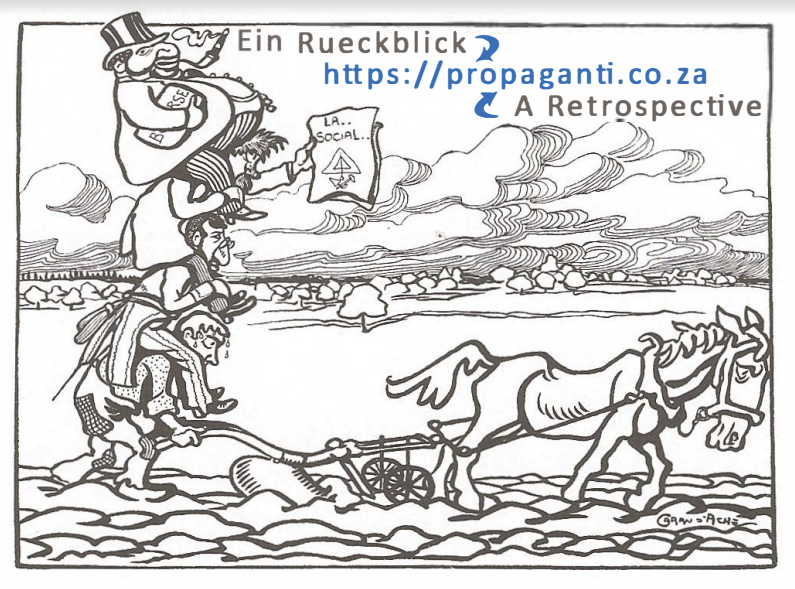


– Dawes plan. (1924) U.S. Loans. Since the “reparations” could not be financed from taxpayers’ money alone and hindered the reconstruction of the economy, loans were needed. A lucrative business plan that was to prove itself again 25 years later in the form of the Marshall Plan. Charles Dawes was a partner of the influential JP Morgan.
– Young plan. (1929) Here the reparations question was partially adapted to the possibilities of the German economy. Owen D. Young was affiliated with the Radio Corporation of America and the Rockefeller Foundation.
Above all, the struggle raged between communist-inspired Spartacists (later KPD) and councillors (Soviets), the professional revolutionaries (as Solzhenitsyn called them) “who by virtue of their revolutionary legitimacy claimed dominant power”, on the one hand, and the resulting volunteer associations that kept these activists in check, on the other. As in Russia and Hungary, a communist regime would also be smuggled into Germany and Austria. Bela Kun, originally from Russia, played a driving role after he led a murderous terror regime for six months in 1919 before he was expelled from Hungary. The Polish Rosa Luxemburg and the Russian Eugen Leviné were up to mischief in Berlin and Munich. By means of a marriage of convenience, Luxemburg had settled comfortably in Berlin and called for class struggle against national aspirations in favor of global interests. In Munich Kurt Eisner instigated a communist revolution with Eugen Leviné, Max Levien and others. Eisner had previously distributed the Eisner-Fechenbach papers. A collection of forged documents that were intended to underpin Germany’s guilt for the First World War and to stir up German hatred among the Allies. These professional revolutionaries were not squeamish in their choice of actions, and were prepared to murder ten innocent hostages. To their great astonishment, they found that there was still enough will to resist and defend themselves, left in the German people. Most of these revolutionaries, along with their henchmen, were arrested, sentenced fast track and executed. Today, Luxembourg is celebrated as an important “philosopher”. After all, she came up with the profound statement: “Only the world revolution of the proletariat can bring order to this chaos“. She can only have meant the chaos caused by her Marxist comrades-in-arms.
In the official reportage of history, one can read the following about this time:
“After the First World War, hundreds of politicians were murdered in Germany. Paramilitary groups from the right wing murdered their enemies without consequences … by 1922 at least 354 members of the government and politicians had been murdered, the way for the Nazi Party and the Holocaust was paved. ”(History.com)
How convenient, a scapegoat found and reality turned upside down, all in one breath. In many other, synchronized “history channels” the description sounds very similar. Wikipedia, which has existed for about 20 years, has simply rewritten, spiced up, warmed up and served up such content as righteous historiography. The resulting imbalance was a driving motive for the writing of this text.
Now back to the reality that is kept hidden in most of the official history channels. “From November 1918 to the end of 1923, more than 20 communist revolts and uprisings took place, all of which were suppressed by the Reichswehr and the Freikorps. The most important after 1918 were: January 1919 in Berlin – 156 deaths, March 1919 in Berlin – 1200 deaths, April 1919 in Munich – 715 deaths, March 1920 in the Ruhr area and Vogtland – 1000 deaths, autumn 1923 in Hamburg and Central Germany – 108 deaths … The SA faced at least two paramilitary organizations of the left, the Reichsbanner and the Red Front Fighters Association, which in 1928 numbered 130,000 men. There was practically a permanent civil war on the go. The SA sufferer much greater losses than the Communists.”
These lines were taken from the extremely readable book, Causes of War – War Guilt, by Helmut Schröcke.
These days, similar conditions prevail again in Germany, with resistance to unbridled opportunism rising once more.