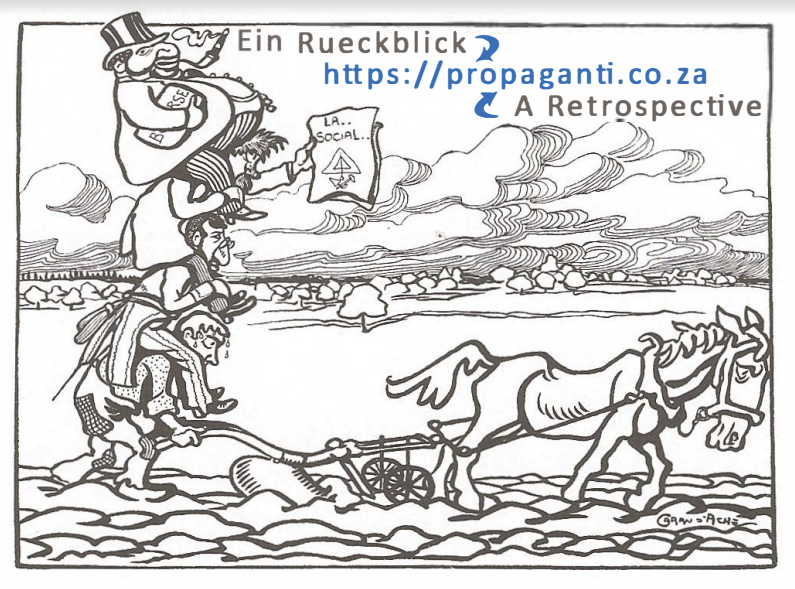


After the Thirty Years’ War. 1618 – 1648.
“Who had won? Yes, who? Someone had to win, that was clear, but who? The Catholic King of France, together with the Protestant King of Sweden, had fought against the Emperor and Pope – and won… On 24. October,1648, the Allies gathered in Münster and Osnabrück and gave the answer: neither German Protestants nor German Catholics had won, but France. Neither Spain nor Italy nor the Roman Church was punished, but Germany. Germany was to blame. Period!
In those days, victors were not bashful to seek ‘reparations’, but spoke quite firmly:
‘Now let us help ourselves, the war must have been worth it.’ France ‘got’ the land and city of Metz, Toul and Verdun, as well as Breisach on the Rhine and all the Habsburg possessions, virtually all of Alsace, and the ‘protection’ over the 10 important cities. Sweden ‘got’ all of Western Pomerania with the islands of Rügen, Usedom and Wollin, the city of Wismar and the entire Duchy of Bremen-Verden with the exception of the city of Bremen. The defeated Bavaria ‘got’ the Upper Palatinate. Switzerland and Holland were officially cut off from the Reich and declared independent states. All German ‘Reichsstates’ were turned into small states with full state sovereignty… Each of these countless small ‘countries’ was now self-governing, it could operate freely, also wage war on its own and strike deals with the foreign powers.
This was the so-called ‘Peace of Westphalia‘. It was the death certificate of the German Empire.”
Twenty years later. Wars of Conquest. 1667 – 1697.
“Louis the Fourteenth, after whom most of the old chairs and tables are named, had become King of France. He had a very sunny nature, which is why he is also called the ‘Sun King’. Twenty years after the Peace of Westphalia, he undertook three raids, which to his own advantage, were instigated completely unexpected. The timing was also favorable, because the German states were attacked in the east by huge throngs of Turkish invaders, who had been kindly encouraged to this enterprise by the ‘Sun King’. While Prince Eugene saved from the Turks, Louis the Fourteenth cut off a few sizeable chunks from German lands in the west. For example six hundred towns, villages and castles in the Alsace-Lorrain, Freiburg, Strasbourg and a huge area south of Alsace up to the Lake Geneva. The twenty-year ceasefire he had concluded with Germany did not prevent him from invading the Palatinate, completely unmotivated in indescibable barbarity. The ruins of Heidelberg Castle still bear witness to this.
I do not know how this story is taught in French schools. But I know what the old minister Richelieu himself wrote: ‘to create an invasion gateway to Germany’.”
The Seven Year War. 1756 – 1763.
“It is very enlightening to look at those who reached out to Frederick: Bavaria, Saxony, France. On the spot, England then allied themselves with Vienna. Frederick the Second (the Great) won the 1st and 2. Silesian War. But Maria Theresa was determined to correct this result. After ten years of zealous diplomatic wrangling, in which she mobilized the vanity and influence of all the ‘underskirts’, she was ready. Again, two camps faced each other, and again we have to look at them closely. In the camp of Austria: Bavaria, Saxony, France and Russia. In the Prussian camp: England.
You are surprised that everything was completely reversed now?… What your and my great-great-grandfather did not recognize, Frederick the Great immediately recognized: the battle was not at all about Prussia, Habsburg or Silesia; it was about something much more gigantic, about the distribution of the newly discovered continents. In North America and India, a world war was unfolding, the first world war in modern history. It was about possessions, that where a hundred times as rich as Europe, about land that was a thousand times the size of Silesia, it was about a very big power game. Neither Vienna nor Potsdam were in this game.