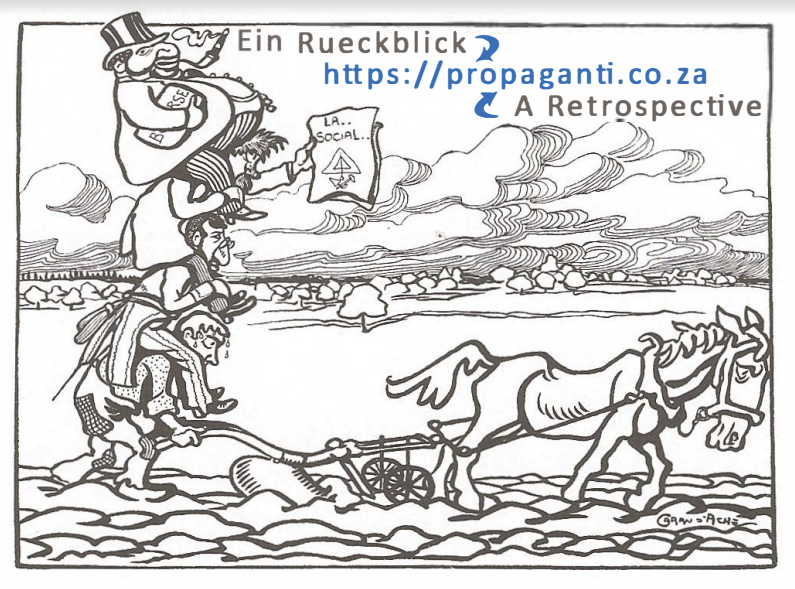


Pacification: “With all due respect – we learned in detail from Marx that the capitalists are the bitterest enemies of proletarian socialism, one cannot count on any help from them, only a bloody war? … Despite the lack of diplomatic recognition [belatedly delivered by F.D. Roosevelt in 1933] of the Soviet state, it was obvious and even stated in the ‘Izvetsija’: The American business world is interested in expanding economic relations with the Soviet Union. Against such an expansion, the American unions went on the barricades to seal their market off from goods manufactured by cheap – because enslaved – Soviet labor. But the ‘Russian-American Chamber of Commerce’ founded at that time did not want to hear of any political resistance to communism and did not want to introduce any ‘politics’ into business relations … The American scientist A. Sutton researched the connection between Wall Street and the Bolsheviks and exposed the amoral mechanisms. It began at the beginning of the century with the so-called Marburg Plan, based on Carnegie’s enormous financial power: The power of international financiers was to be strengthened on the way of ‘socializing’ the countries of the world – ‘to control’ … and to enforce pacification. ‘ Sutton’s conclusion: ‘The international financial world prefers to deal with centralized governments. The world of banking least of all wishes for a free economy and decentralized state power, but exactly the opposite … The revolution and the international financial world are not strongly at odds with one another, provided that the revolution creates a more centralized power apparatus and so that markets of these countries can be steered … the Bolsheviks and bankers had an essential common platform: internationalism‘… As such, it is not surprising that Morgan and Rockefeller wholeheartedly supported the collectivist projects and large-scale destruction of individual rights” (A. Solzhenitsyn. 200 years together. The Jews in the Soviet Union.)
This most enlightening book has thus far (2022) been prevented from hitting the bookshelves in an authorised English translation.
Morgenthau and the Russian Foreign Minister Litvinov (alias Meier-Wallach) arranged the diplomatic recognition of the communist regime mentioned above on November 16, 1933. Josef Stalin said he was
delighted with the new “allies” and the future partitioning of Germany was already considered during those talks.
House Banking Committee President L. McFadden remarked that same year,
“You will be amazed at how much American money has been withdrawn from the United States’ treasury for the benefit of Russia.”
From that point of view, it is not surprising that we can recognise many parallels with the present day; poke around in the hornet’s nest with professional revolutionaries until a war becomes reality; covertly support both parties in the war until the slaughter has reached its climax and one, or possibly several, are devastated. The “elites” in the background can now take it easy or, to complete the destruction, start a revolution. The crises, although today in slightly modified form, are still being organized and still deliver the desired results. Wolfgang Schäuble, prominent politician of the Merkel years, and his colleagues have also made use of this knowledge, as we will read in a moment. Of course, the charade only works if you have the concentrated power of the licensed media behind you, like Walter Duranty from the NYT had in Moscow. Concealing reality, minimising, exaggerating or spreading “fake news” is a piece of cake for them.
In this context, a statement made during August 2020, the year of the “great pandemic,” is interesting. “The Corona crisis is a great opportunity to manage the EU economy and finance union, to reach goals which we have not yet achieved politically … Resistance to change is less during a crisis.” Said none other than Wolfgang Schäuble. Crises, whether real or manufactured, have always been popular with our elites.