

Neville Chamberlain, British Prime Minister (1937-1940), was more honest when he noted that “the Jews exerted strong pressure on me to dissuade me from any agreement with the Führer. ”(Schrὃcke)
Since the Polish leaders knew to whom they owed the rise of Bolshevism, they also imprisoned many Jews into their new concentration camps. A representative of the American Jews, Henry Morgenthau, showed up immediately to investigate the matter for effective media coverage.
During this time, a solid foundation was laid for the later Bromberg Bloody Sunday, during which at least 5800 Germans lost their lives, and for the Hitler-Stalin Pact of 1939.
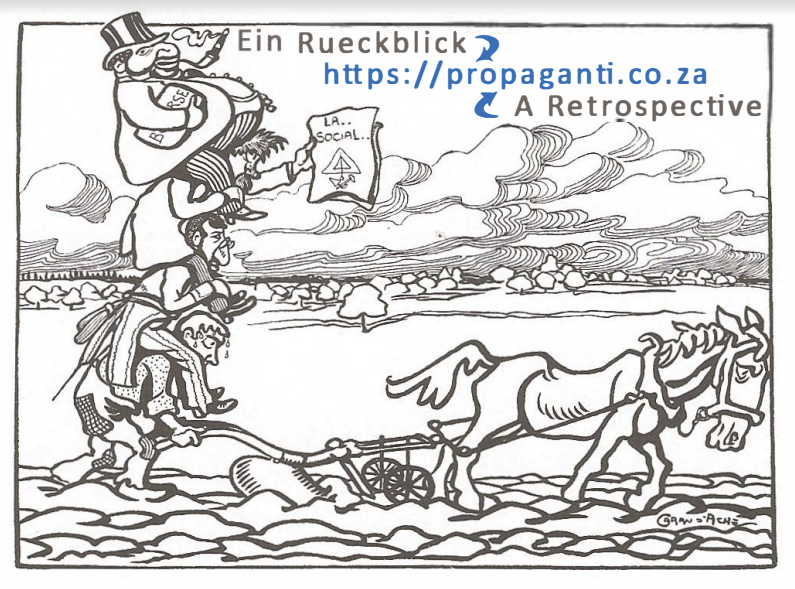
In Russia, Josef Stalin and his sponsors on the American east coast got cracking, to spread their utopia of the collective in which all people are equal, worldwide. Two opponents had to be defeated. The nation-states, naturally grown units, inhabited by people with common interests and cultural background, as well as capitalism, an economic form in which above-average performance is rewarded, unfortunately often above-average. The comrades believed that the parasitism, which is located in capitalism on the upper levels, would not equally nestle comfortably in communism / socialism on the lower and upper levels, at the expense of the shrinking middle class. But they had clearly recognized that in order to achieve their goals in the various countries in which their “professional revolutionaries” and agitators were operating, unrest and uncertainty on an economic and political level had to be created. To do this, money and propaganda had to be under their control, and the relevant agents had to be positioned in politics and unions. In the USA, especially on the east coast that was already the case, in Leningrad a lot remained to be done, though not a big problem in a totalitarian regime. This recipe applied to today’s world sounds somewhat familiar. The slogan – “destruction as creative lust” is popular again. Once again, bustling ideologues promised freedom, equality and fraternity; all over again this idea turns out to be an illusion.
Today we recognize more and more clearly as an illusion that capitalism and communism are fundamentally different.” One senses with good reason that the deployment of Capitalist and Marxist ideology have the same historical roots.”(Theodor Heuss. 1932.) “The mass-social systems of communism and capitalism are identical, anchored in the dogmas of an enlightened ideological liberalism, in the spiritual uprooting of nations. Ethnocide begins with the mish-mash of national cultures. ”(Alexander Solzhenitsyn, quoted in – Causes of War – War Guilt by Helmut Schrὃcke.)
In this case, capitalism should not be confused with the social market economy of the NSDAP or of Ludwig Erhard.
Early on, the aforementioned group of people in the USA. discovered the joy of “destruction as creative lust”.
The head of the branch office of the New York Times (founded in 1851, owned by Adolph S. Ochs since 1896) in Moscow, Walter Duranty, was able to fully deploy his talents in this position. Well-funded, he was able to organize wild parties with alcohol, drugs and prostitution and use his influence to good effect. A film has even been made about these occurrences in Moscow , Mr. Jones, but it doesn’t even come close to reality.
Thanks to his help, Stalin’s propaganda machine was extremely successful in glossing over the economic situation in the “worker’s paradise”. Duranty also managed to keep news of the 1932-33 “Holodomor”, the genocide instigated by Stalin’s aides that killed millions in Ukraine, Khazakstan, and other areas, from being published. The number of victims is estimated at between 3 and 10 million, depending on the source.
Without a doubt, the best overview of the circumstances and events that led to the Russian Revolution was published by Alexander Solzhenitsyn in his two volume book – Two Hundred Years Together. In the chapters, – In the February Revolution – The year 1917 – With the Bolsheviks – In the civil war – The twenties, he analyses incorruptible and mercilessly. In chapter 7 he comes to speak of the aforementioned “Holodomor”.