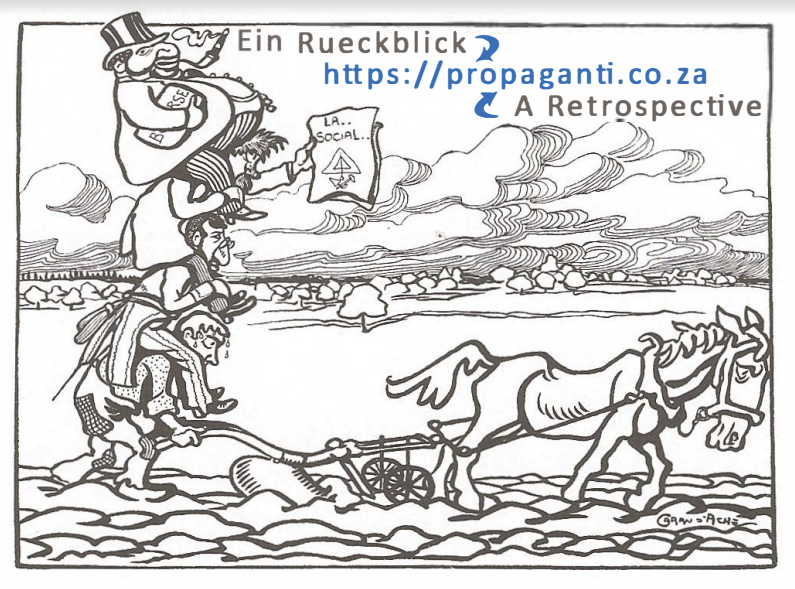


Interventions, such as in France (formation of a popular front government in 1934), in Spain (civil war 1936 – 1939) were part of the recipe. It is questionable whether a more moderate development would have taken place under Trotsky’s leadership. We remember, it was he who came with a bag of money and a new American passport before the revolution; made possible by the relevant circle of influential people around US President Wilson. Trotsky became known as a radical agitator and organizer of the Red Army, underpinned by bloodthirsty quotes that he liked to utter. “What pleasure our young men take in destroying the Russian intelligentsia, officers, academics and writers. If we establish the power of Zionism on the wreckage of the revolutionary burial, we will become a power before which the whole world will bend.” His comrade Stalin did not need to feign tolerance either, like his ”followers” do today, in order to allow intolerance and totalitarian thinking to flourish.
“After examining Trotsky’s biography, I agree that Trotsky had nothing specifically Jewish in his affinities, but was a passionate internationalist. [Now we know from which corner many of the actors in the Bundestag draw their ideological inspiration.] With such a tribal affiliation it would perhaps have been easier to condemn him? But as soon as Trotsky’s star rose from the spring of 1917, too many people were proud of him, and he became almost an idol among the radical left circles of American Jewry … The rapid successes of the Jews in the Bolshevik administration naturally did not go unnoticed in Europe and the USA, and shamefully aroused nothing but joyful approval. At the turning point between February and October, the Jewish public in America continued to be full of sympathy for the Russian Revolution … Remembering history should not be a reckoning with one another. It is not meant to be a mutual accusation, but rather to explain how the Jews became so excessively involved in the rise of a state that was not only insensitive to the Russian people and without any organic connection to Russian history, but also brought its inhabitants all extremes of terror. ”
(Alexander Solzhenitsyn. Two hundred years together. – The Jews in the Soviet Union.)
When the civil war raged in Russia (1917-1923), the Eastern European countries set out to become sovereign states; as expected, partly overshadowed by an opportunistic urge to expand.
Most Poles were not inspired by the communist ideology, least of all by Lenin’s strategy: “We have to destroy the wall that separates the Soviet Union from revolutionary Germany.” The Pravda of May 9, 1920, stated thus: “Through the body of white Poland leads the way to the world inferno. On the bayonets we will bring happiness and peace to humanity. Forward to Berlin, over the body of Poland.”
When the Bolsheviks were still fighting with the White Russian forces, with the Japanese, British, French, Americans and the Czech Legion, in 1919, Poland set out to expand. Under Marshal Jozef Pilsudsky, the nation expanded westward under cover of the Versailles negotiations. The Versailles guidelines to the east were ignored (Curzon line) and parts of Belarus, Ukraine and the Baltic states were occupied with French help. Charles de Gaulle acted as advisor, and as early as 1921 a military alliance between Poland and France was concluded. In the former German provinces (Posen, West and East Prussia, Danzig, parts of Lower Silesia and all of Upper Silesia), which were now Polish according to the Versailles dictates, a brutal de-Germanisation programme was initiated, a genocide in the true sense of the word. Following the example of the British mass internment of the Boers in South Africa, large numbers of German residents of these areas were put in concentration camps. At least 12 camps of this type were located on Polish and Czech territory between 1918 and 1923. More information on the topic can be found in the studies: “Death spoke Polish” – “Poland’s guilt in World War II” – “Blood Sunday in Bromberg” and “Documented Polish Cruelties”, based on documentary evidence published by the German Foreign Office. Since the annexation of the German eastern territories after 1918, the Polish government began using terrorist tactics to expropriate, murder and expel the German population. By 1939, 1.5 million had left their ancestral home, either forced or voluntarily. These atrocities took place openly under the benevolent supervision of the League of Nations and the Allied control authorities. The Catholic pulpits were used to stoke up emotions and, at times, weapons were supplied. After the British guarantee to Poland, the terror increased to such an extent that the German government was forced to act.
It turned out that the arbitrary borders, drawn in flagrant disregard with the peoples’ right to self-determination, would lead to new conflicts. Could it be that the outcome was planned that way?
In this context, the following statement by former war premier (1916-1922) Lloyd George is interesting.
“All of the documentation that certain people from our allies leaked to us was falsified and fraudulent. In Versailles we made decisions on the basis of forgeries. ”(Quote from October 7, 1928. Schrὃcke.)
Who could he have meant with the term “certain people”?