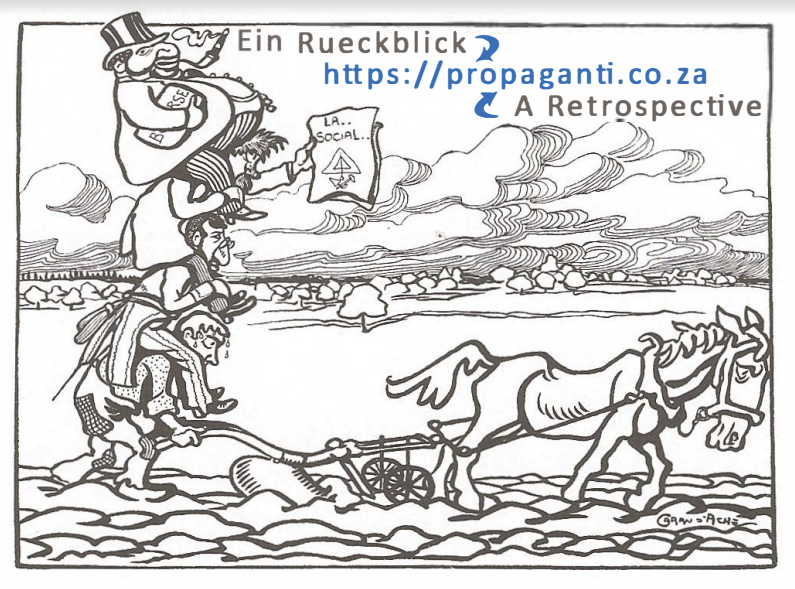
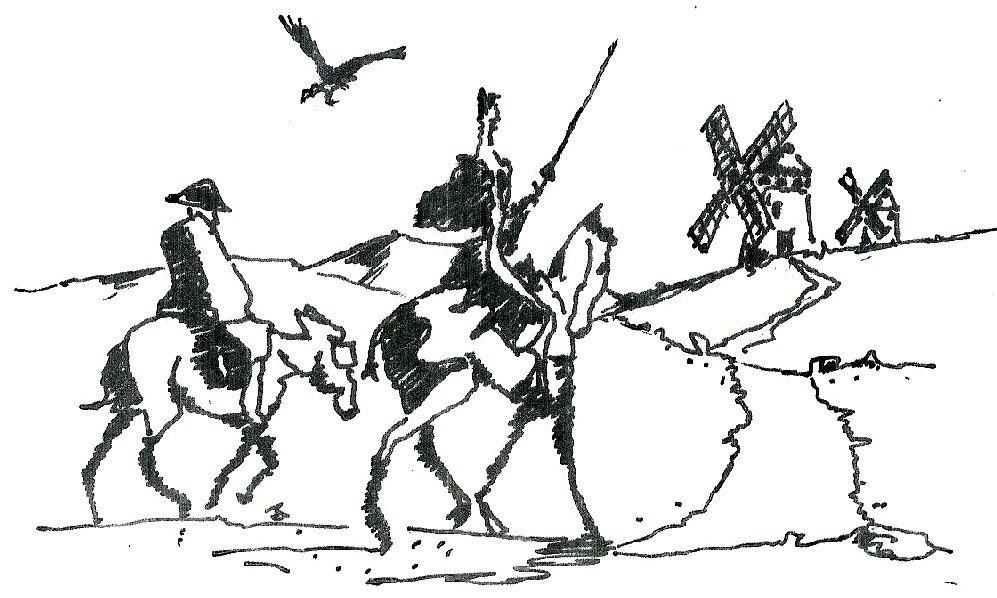


The battle began when Napoleon was still in the Orient. Barely returned, he wasted no time. The battles took place on German territory, entire regions looked horrible, towns and villages burned to the ground, thousands of dead bodies covered the fields. The little general with his bulging belly in the white pants, silently and without emotions, received the messengers, who begged for peace. He dictated a peace that they could not believe…
In Vienna, people were horrified. They had not anticipated such brutality. The French were intoxicated. Gloire! Gloire! Liberte’, Egalite’, Fraternite’ – all good intentions had gone overboard… On the 18th.of May,1804, they proclaimed General Napoleon emperor of the French.”
Goethe experienced these times first-hand, and his assessment is instructive. “Legislators and revolutionaries who promise freedom and equality at the same time are either psychopaths or charlatans.”
“Now it came swiftly. Prussia incorporated Hanover, England then declared war on Pussia. Sweden joined England. Napoleon offered Hanover to England. He simultaneously occupied Prussian territory with his French troops. There they stood, the gullible Germans, Napoleon had the war he wanted. France now stretched from Gibraltar to Lübek.”
But Napoleon had not had enough.
“Once again, Europe was placed in the juice press and more was extracted. In May 1812, a huge wave of soldiers poured into Russia, more than half a million French, German, Italian, Swiss, Dutch, Spaniards and Poles. In the Foreign Legion alone 30 000 Bavarians, 30 000 Austrians, 20 000 Prussians marched. Behind them were the bayonets of the French. In the midst of his guard, the short revolutionary general, now successor of Charlemagne, rode east…
The East showed for the first time the system of ‘scorched earth’. It’s all happened before, says Ben Akiba. You just have to know history… Out of 30,000 Bavarians who had moved out, 27,000 did not return home. What for? On the obelisk, which King Ludwig of Bavaria erected in Munich, the dishonest inscription reads: ‘They died for the liberation of the fatherland‘…
From the ruins of Germany, in this hopeless situation, the country abruptly stood up. Prussia rose. The fantastic spectacle of the outburst of despair of an entire people, which began the struggle for liberation in 1813/14. What happened in preparation is very interesting and much different from what is being taught… Yorck, the commanding general of the Prussians, had adopted a wait and see stance in the Russian campaign and then broke away from the French. On his own he negotiated the agreement of Tauroggen against Napoleon… Scharnhorst trained a new army ‘within the limits of what was permitted’ in a fast-track procedure. This was the order of the king, Friedrich Wilhelm 3, who suddenly stopped playing the organ but signed orders. He also knew how Tauroggen had come about: all the Russian generals who led the negotiations were born Prussians: General Diebitsch, Lieutenant Colonel Clausewitz, Lieutenant Colonel Dohna…
The Tsar’s threat was the only thing that prevented Napoleon from completely erasing Prussia. He had planned it. He offered the Tsar the division of world domination into East and West, through the middle of Germany. So, this idea is not new…
Few know what the exact terms of peace with Prussia [before Napoleons move on Russia] looked like: he took away exactly half of the country… The rest of Prussia received an occupying force of 160,000 men, at that time a huge number. Everything came at Prussia’s expense. In addition, there was ‘war compensation’, the annual numbers of which were not even fixed.”
Napoleon finally defeated.
“The Peace Congress met in Vienna. The comet was down, and rests under a marble dome in Paris, and the bombastic Arc de Triomphe looks over from the Champs-Elisees. The German people looked longingly to Vienna, where the congress met. They had no idea that we Germans had only been henchmen, thirty-nine small states, individually powerless and in no trade union… France, the indispensable requisite of ‘European balance’, remained almost untouched… All international friction points were carefully maintained, no absurd borders eliminated. The situation was too tempting. German delegates had to watch the pathetic spectacle, had no influence at all… The English had taken possession of Hanover again…The disappointment among the 39 German countries was massive…
An English diplomat mentioned to a German envoy about the verdict. ‘You are a castrated nation!’ “
What does history tell us: Some light figures find their final resting place under marble, others are buried under history garbage.
Bismarck’s short war, Prussia against Austria. 1866.
“The official reason for the conflict with Austria was: Austria wanted to make a 40th state of Schleswig-Holstein, Prussia demanded the end of creating small statelets and wanted to incorporate – one part to Austria, the other part to Prussia… In Vienna, it was gradually recognized that Bismarck was determined to achieve his goals…
Bismarck knew that France had its eyes set on Belgium. He knew Napoleon 3, the nephew of the world conqueror, who had just established a new monarchy, well from his time in Paris. He told him of his suspicions. Napoleon, caught off guard, confessed. Bismarck then told him that If France seizes Belgium, they will immediately have England as their opponents. It will also have Vienna as its opponent. He will need Prussia as an ally, Bismarck whispered confidentially… That made sense to the Frenchman… Austria was in a hurry: it turned to the Bundestag and sued Prussia. It made promises, especially to the southern German countries. The cheapest imperial official tour was exploited… 10 days after the beginning of the war, the decision was already reached at the Battle of Königsgrätz. Moltke defeated the Austrians completely… King William was thrilled. He wanted to march straight to Vienna. Now Bismarck’s towering format came to light. He sharply opposed the tumultuous high spirits, threatening the king with his resignation if the troops went even one step further… Austria was treated like a gentleman. The German countries, which had been on Vienna’s side and were now trembling, were not punished.”
It has been proven that since the third French Revolution, Polish and French professional revolutionaries have repeatedly appeared in major German cities in order to spread their ideology. In 1866, one of these “Democrats”, named Cohen-Blind, attempted to assassinate Bismarck. Later, some historians and philosophers tended to believe that Bismarck’s policies had hindered the development of democracy. How one could arrive such a view is a mystery. Bismarck was a thoroughly convinced parliamentarian. (Not to be confused with the widespread anti-democratic lobbying that is widespread these days.) As Fernau describes, it was Bismarck who, after three failed revolutions and three Napoleons, helped the French build a sustainable democracy by removing the last Napoleon off their shoulders. He promoted a monarchy only because he had realized that many people depend on their adored idols. One look at today’s “social networks” and the corresponding programs in the state broadcasters, will amply confirm this. These days, “followers” are not fussy in their selection of icons. Some of them are satisfied with disabled, remotely-controlled teenagers. The cult of personality worshipping also prevents people from worshipping themselves.
Bismarck’s short war. German – French War. 1870 – 1871.
“In all innocence for his benevolent restraint [during the war of 1866] Napoleon III demanded the German Palatinate, Hesse, Belgium and Luxembourg. Bismarck asked for written confirmation. When he had it, he put the letter in his pocket and refused. Anyone who wanted to read the letter got to see it… There was a general feeling that Bismarck was pursuing a policy without any intrigue. Twenty Northern and Central German states asked to be included in Bismarck’s ‘North-German alliance‘… It was clear that foreign nations would not accept this accumulation of power around Prussia and the unification of the empire… Bismarck knew who would strike… Napoleon’s. interference in Poland had failed. His expedition to Mexico, completely insane, had failed. England had prevented a planned occupation of Syria. The attack on Belgium was thwarted by Prussia. Finances were poor. The whole officer corps suffered terribly from a lack of glory…
Napoleon’s answer [based on an invented scandal] was the declaration of war! All of France was up in arms. A Boche had dared to have a French diplomat dismissed by a lackey… Moltke mobilized so quickly that German troops crossed the western border before Napoleon had set himself in motion… In 40 days the French army was crushed… After the Battle of Sedan, Napoleon III. surrendered… The French Republic continued the war… [With British money, to which Bismarck swiftly put an end, with a smart diplomatic deal] The Republic capitulated, France was down and out… Bismarck dictated a mild peace, as always. Three years after Versailles, France already had a bigger armed force than the whole of Germany… In 1890, Bismarck was retired… On the same day that Bismarck left, the Russian envoy Count Shuvalov had come to Berlin to renew the old alliance treaty. With deep astonishment, he saw another man sitting at Bismarck’s desk. So enormous was the personal prestige of the old Reich Chancellor that he hesitated… Three days later, the young emperor rejected the renewal of the treaty as unnecessary and as irritating to other powers. In this hour and with these words, William the Second spoke the Death penalty over the German Reich… The new partner of the Russians was already waiting with open arms: France. The jaws of the big crush were set… England and France breathed a sigh of relief, began a busy negotiation activity“. (Joachim Fernau. Germany… from start to finish.)
Bismarck, had managed to reunite 39 German small states, that were constructed mainly by foreign powers, with their own “rulers” and administrative systems. The man who was unsympathetic of the merciless exploitation of the colonies, who instead focused on the development of the domestic economy, even though he knew that, “The only way to improve German-English relations would be to scale down our economic development. And this is not possible.” Under his direction, the merchant fleet was expanded and economic links were strengthened. Construction of the Anatolian Railway Line began, a project that was later extended to the Berlin-Baghdad Railway. No wonder that in Paris (since the Great Masonic Congress in 1889), in London and even in Moscow, as A. Solzhenitsyn reports in “200 Years Together”, the previously mentioned professional revolutionaries were on the streets in large numbers. Negotiations and manipulation was the order of the day. Gavrilo Princip the assassin of Sarajevo (as well as Herschel Grünspan, who murdered Ernst von Rath in Paris in 1938) was managed by the secret elite with great care, an early operation “under false flag”.
Against this background, one of the German public broadcasters (ZDF. 5. May.2019) had the urge to state the following. “Germany has a history of war with virtually all neighboring states.” Thus history of several centuries, can be distorted by erasing a deciding detail. Assuming that the audience has been conditioned for years to swallow such “information” without protesting.